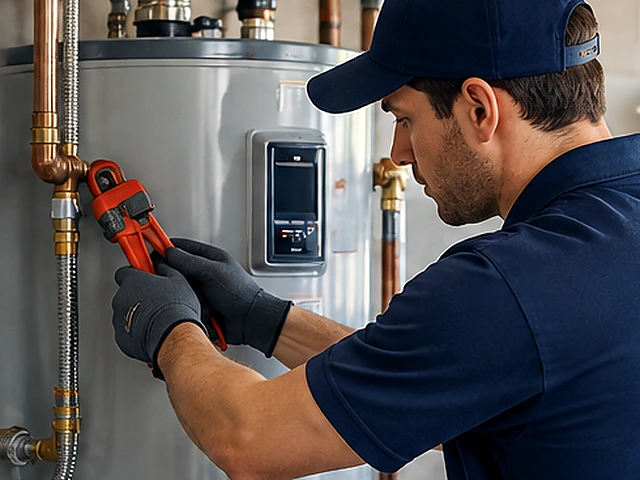
CA-GoodHome provides water heater earthquake and seismic-safety work for California properties, focused on the heater’s restraint, supporting conditions and the agreed improvements to its installation. The actual equipment, location and attachment surfaces determine the work.
An existing strap does not by itself establish that the complete arrangement is suitable. Share photographs and available installation information for assessment. The proposed restraint and supporting work need project-specific review of the equipment, site and applicable requirements.
Related paths: Services Hub, Hot Water Recirculation Pump, Expansion Tank Installation.
Water Heater Earthquake / Seismic Safety
The scope concerns the heater, restraint components and the supporting construction they rely on. It may involve reviewing an existing arrangement or carrying out specifically defined restraint improvements alongside other heater work.
The services hub separates this task from appliance repair and other plumbing projects. State whether there is a known loose or damaged component, an upcoming replacement or simply an existing installation to assess. Do not move or shake the heater to test it.
Strapping and Bracing Context in California
Restraint suitability depends on more than the visible band around the tank. Attachment, supporting material, component compatibility and the actual heater configuration all need consideration.
Provide the California location and any previous installation records. Applicable requirements should be checked for the project without assuming that a generic diagram applies to every property. The service scope should identify proposed corrective work and any underlying conditions that must be addressed separately.
Mounting Surface and Heater Location
The wall, framing or other supporting construction affects how restraint work can be approached. A finished surface can conceal information that is not visible in a photograph, so its suitability needs assessment.
Show the heater in relation to nearby walls and other equipment. Note known deterioration or previous alterations around the attachment area. Repairing damaged support or changing the installation location may be broader work than replacing a restraint component.
Gas Connector and Shut-Off Context
Nearby utility connections need to be considered when reviewing the installation, but restraint work should not be assumed to include gas-system alteration. Identify the heater’s energy source and any proposed connection changes separately.
If a gas leak is suspected, leave the area and contact the utility from a safe place, using emergency services for immediate danger. Follow California gas-emergency guidance; do not wait for a routine safety-work appointment or attempt a gas repair.
Garage/Stand and Clearance Questions
A garage, closet or utility room can present different access and surrounding conditions. Show any stand or platform, nearby walls and the space around the equipment. The heater model and actual arrangement determine what must be assessed.
Do not assume that changing a strap resolves issues with the stand, surrounding construction or required access. If those conditions need work, identify them separately before the restraint project is treated as complete.
Existing Installation Review vs. New Installation
An existing installation can be assessed for a defined safety-improvement project. A new heater or relocation may change its dimensions, attachment conditions and supporting work, so the old arrangement should not simply be presumed suitable.
For equipment changes, coordinate with water heater installation or water heater replacement. Other components remain distinct: expansion tank installation concerns thermal expansion, and water pressure regulator / reducing valve service concerns pressure control.
What to Share Before Service
Provide the heater model or type and size if known, its location and safe photographs of the full unit, restraints and nearby supporting surfaces. Include any known damage or planned replacement and the California city or ZIP.
For a planned heater replacement, include the proposed model and location so restraint and support can be assessed for the new equipment. Use the contact page to distinguish work on the existing heater from preparation for a replacement.
Frequently Asked Questions
Is the heater currently strapped?
Share photographs of visible restraints and their surroundings if safely accessible. Presence alone does not establish suitability; the attachment and support need assessment.
Where is the heater located?
Identify the garage, closet, utility room or other area and show nearby walls, equipment, access and any stand.
What heater size and type information is needed for a seismic-restraint assessment?
Provide the model and labeled capacity if known, along with a whole-unit photograph. Equipment configuration helps define the restraint assessment.
Is this part of a replacement or a safety-only project?
State whether the heater stays in place or will change. A replacement or relocation may change the restraint and support arrangement and needs coordination with that larger scope.
Call About Water Heater Earthquake / Seismic Safety
Call CA-GoodHome at (223) 226-1828 with the California city or ZIP and the project details that matter most for water heater earthquake / seismic safety: heater type/size, wall or framing condition, existing restraint, clearance and current installation. If the work crosses into a related service, use the related links on this service to identify that scope before the call.
Related Services
Discuss your project
Share the service, California city or ZIP, and the main project details.